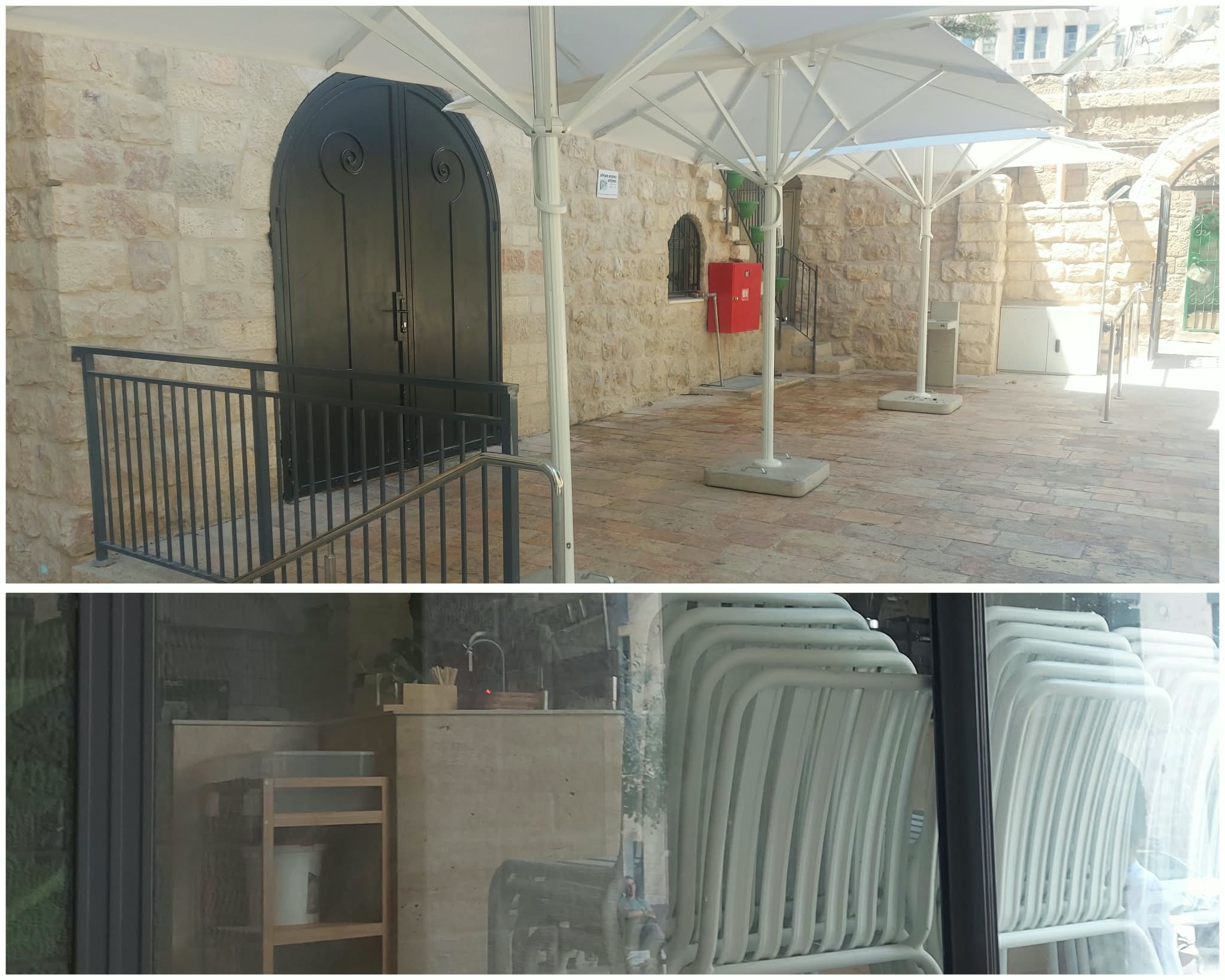
Anyone who passed through Agripas Street in Jerusalem on Saturday, September 5, saw the final result of a battle that lasted almost the entire summer: Cafe Basimta was closed. This was not a one-time closure and not a break for a single Shabbat. From now on, the cafe will no longer operate on Saturdays. The decision was made by the owners and management, over the heads of those who had actually operated the cafe on Shabbat, following weeks of protests and confrontations.
The cafe opened at the end of May, and by early July it had become the focus of an organized ultra-Orthodox protest because it operated on Shabbat. On July 4, a major confrontation already erupted at the site, and owner Yoel Ben David said at the time that he intended to keep opening. In the weeks that followed, protesters returned again and again, while secular, traditional and religious Jerusalemites came to support the cafe and those running it.
Is Cafe Basimta’s Shabbat closure a victory for Jerusalem’s ultra-Orthodox protesters?
In terms of the outcome, yes. On Thursday, the cafe’s management announced that beginning with this past weekend, it would close on Shabbat and Jewish holidays. For the protesters, the message is simple and dangerous: pressure works.
When repeated demonstrations, confrontations and an intimidating atmosphere end with a permanent change in the way a business operates, a clear incentive is created to use the same method against the next business.
And this is no longer limited to a cafe. On Friday evenings in central Jerusalem, it is increasingly becoming normal for people to be reprimanded for walking around with a mobile phone, especially if they are talking on it or taking photos. This is how a public space can change without a city council vote and without a new law: those who feel entitled to dictate how others should behave simply begin doing so.
Is ultra-Orthodox demographic growth changing Jerusalem’s public space?
In Jerusalem, demographics create more demographics. When an area becomes increasingly ultra-Orthodox, institutions, synagogues, tailored commerce and additional political power follow. Secular and religious-Zionist residents who feel that their way of life is being pushed out may leave, and every departure further strengthens the demographic shift already underway.
Both the Jerusalem Municipality and Israeli governments have operated for years within this reality. Benjamin Netanyahu has built governments over long periods that relied heavily on ultra-Orthodox parties, and that political alliance has given the ultra-Orthodox public influence extending far beyond its parliamentary representation.
The result can be seen not only in elections, but in the character of streets, neighborhoods and public spaces. When one population grows while others feel increasingly unwelcome, the process feeds itself.
Is Jerusalem’s religious-Zionist community now discovering that its own space is shrinking?
For years, it seemed that secular residents were the first to leave. But Jerusalem’s religious-Zionist community, which remained in the city after many secular residents moved away or left neighborhoods that became increasingly ultra-Orthodox, is now discovering firsthand that the pressure does not stop at the line between ultra-Orthodox and secular.
People who observe Shabbat but do not want the entire city center to function according to ultra-Orthodox norms are also finding that their public space can change over their heads.
Cafe Basimta did not close for one Shabbat. From now on, it will remain closed on Saturdays. That is precisely what turns this story from a local victory into a warning sign for anyone who wants Jerusalem to preserve a diverse public space.