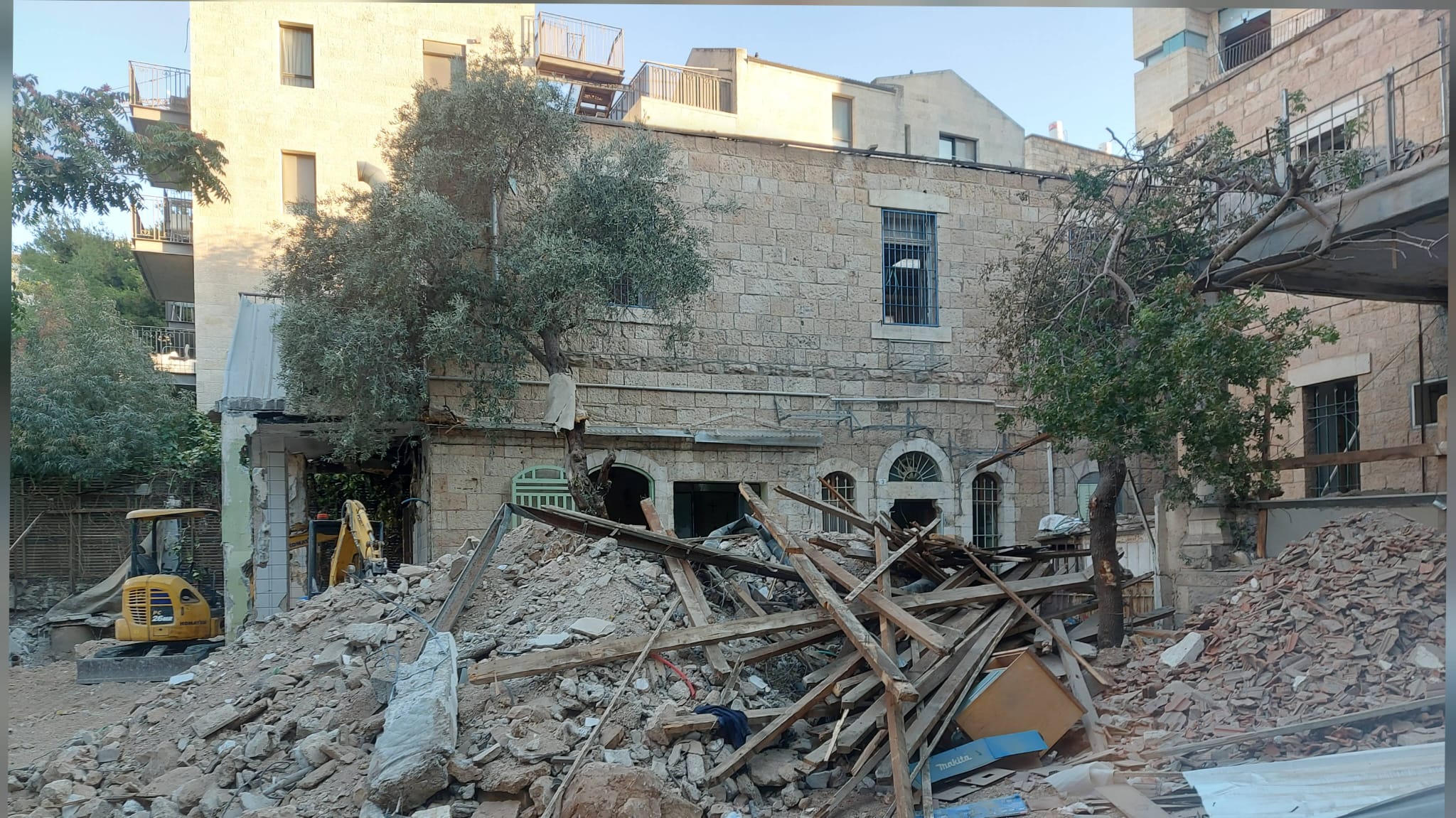
Huge piles of stones and broken concrete now cover the courtyard. Wooden beams lie scattered across one another, a small excavator stands to the side, and parts of the old Jerusalem stone building remain in the background. It is difficult to imagine that this demolition site was once home to Link Restaurant, a place whose tables filled every weekend with families, young people, artists, members of the local bohemian scene and loyal regulars. Demolition and clearing work is now underway ahead of a future real estate project.
The scene takes on added meaning precisely now. For four consecutive Saturdays, Cafe Basimta, a new cafe on Agripas Street, has been the focus of ultra-orthodox protests because it operates on Shabbat. Customers and supporters have arrived to oppose the demonstrators and defend one of the few remaining places to spend time in the area on the Jewish day of rest. At the same time, the non-kosher Satya Restaurant on Keren Hayesod Street has announced its closure after 12 years. The three venues are different, but together they tell the same Jerusalem story: a city in which secular culture is fighting for an increasingly limited place.
What happened to Link Restaurant on Hamaalot Street in Jerusalem?
Link opened in 1997 under Jerusalem restaurateur Yehuda Aslan and operated for 22 years at 3 Hamaalot Street. It was a non-kosher restaurant and bar that served seafood and remained open on Friday evenings and Saturdays. Beyond the food, it became a social and family gathering place associated with the secular and bohemian Jerusalem of the 1990s and 2000s.
Link closed in early March 2019 after its lease ended. Its owners were offered the possibility of continuing to operate at the site under a kosher format that would require closing on Shabbat, but they refused to erase the restaurant’s identity. Today, the tables and crowded terrace have been replaced by rubble and construction equipment.
Why has Cafe Basimta in Jerusalem become a symbol of the Shabbat struggle?
Cafe Basimta recently opened near Agripas Street, an area where very few businesses operate on Saturdays. The recurring protests outside the cafe have turned a small business into a citywide test: will pressure from protesters determine which businesses may operate in central Jerusalem, or will secular residents also retain a place in the city during the weekend?
While ultra-orthodox demonstrators protest what they see as the public desecration of Shabbat, supporters arrive to strengthen the cafe through their presence and purchases. The confrontation has therefore moved far beyond a narrow alleyway. It has become another chapter in the long-running dispute over the character of Jerusalem and the right of different communities to live according to their own way of life.
Why is Satya Restaurant in Jerusalem closing after 12 years?
Satya operated at 36 Keren Hayesod Street, served non-kosher food and remained open on Shabbat. Its management described the growing difficulty of keeping a non-kosher restaurant alive in Jerusalem. The closure cannot necessarily be attributed to one single cause, but it highlights a broader problem: when secular young people leave the city, tourism weakens and the target audience shrinks, even established institutions struggle to survive.
Link has already become a demolition site, Satya is closing and Cafe Basimta is fighting to remain open. Together, they reflect a Jerusalem that is becoming increasingly ultra-orthodox, while its secular population and local bohemian culture are pushed into a steadily narrowing number of streets and venues.