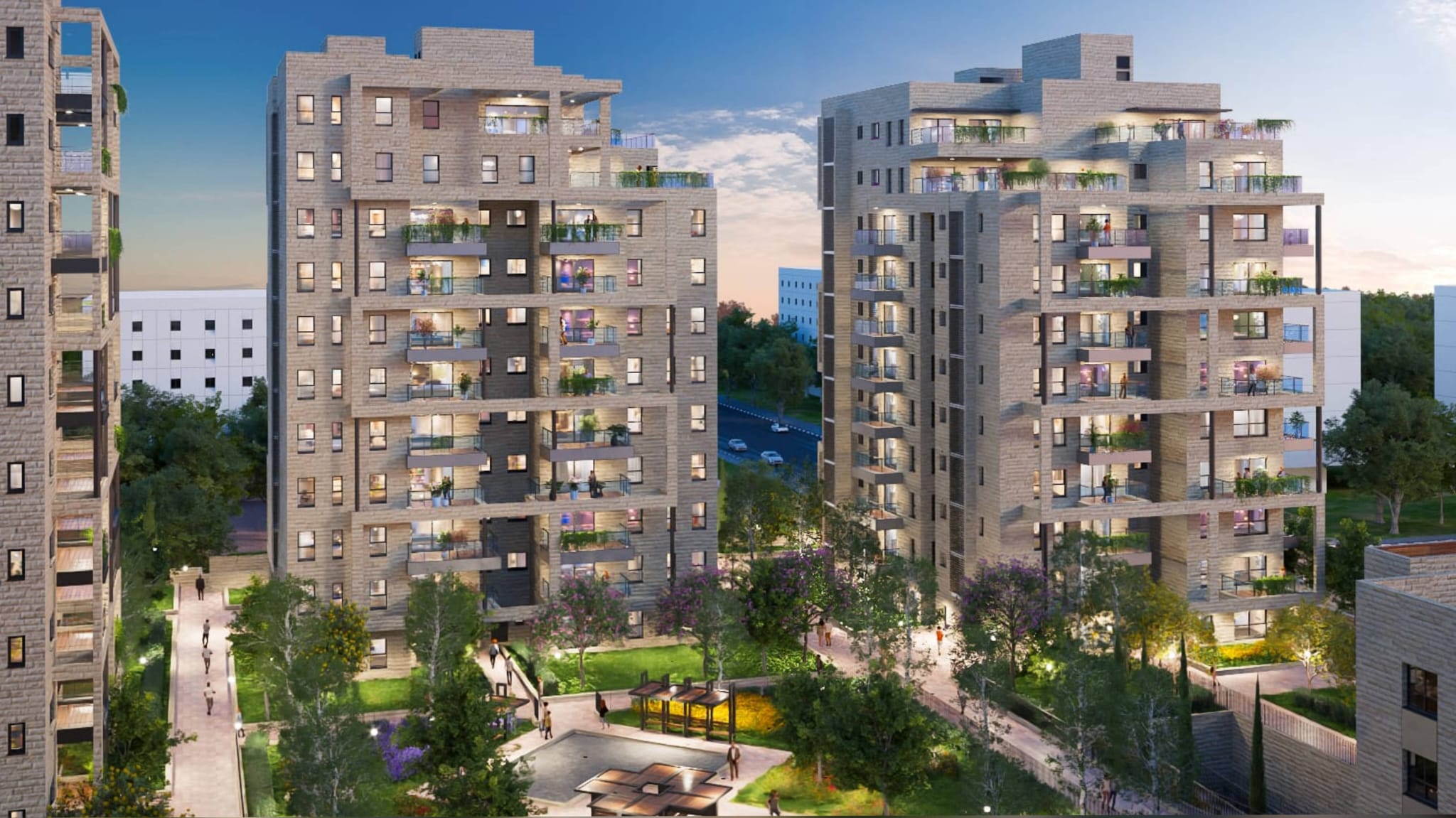
“These are the future faces of Israel’s capital, Jerusalem,” Mayor Moshe Lion said this week following approval of a 42-story tower at the city’s Entrance District. Yet this project is only one part of a series of planning decisions made in recent days. At the same time, three extensive urban renewal plans were approved in Kiryat Hayovel and Givat Shaul, including approximately 3,000 new housing units and towers rising as high as 35 stories. More than anything, the past week illustrates the direction in which Jerusalem is moving and raises one question: Is the capital changing only its skyline?
Why Is Jerusalem Building More and More Towers?
For many years, Jerusalem stood out precisely because it did not embrace the high-rise culture that characterized other Israeli cities. Low-rise neighborhoods, streets with a strong sense of community and a restrained urban fabric were an inseparable part of Jerusalem’s identity. Even when the city’s first high-rise, the 17-story Jerusalem Tower, opened in 1970, it was seen as an exceptional event rather than the beginning of a broader trend.
Over the past decade, however, reality has changed. Urban renewal plans, limited available land and the need to add thousands of housing units are pushing Jerusalem toward taller construction. Areas such as the city’s Entrance District, Talpiot, Kiryat Hayovel, Hebron Road and Givat Shaul are gradually changing, with new complexes featuring mixed-use development, residential towers and advanced transportation infrastructure.
The figures also demonstrate the scale of this transformation. According to data from Israel’s Central Bureau of Statistics and the Government Authority for Urban Renewal, Jerusalem led Israel in 2024 in the number of permits issued for urban renewal projects. At the same time, there was a significant rise in the construction of residential towers exceeding 21 stories. By 2025, construction starts in buildings of 16 stories or more accounted for between 54% and 61% of all construction starts in the city, a 22-fold increase compared with 2016.
Does High-Rise Construction Suit Jerusalem’s Character?
Some view the trend as a natural stage in the development of a modern capital, while others believe it represents a deeper transformation that is bringing Jerusalem closer to the urban model familiar from Tel Aviv and the greater metropolitan area.
Hagai Bronstein of Hagai Real Estate Brokerage believes that high-rise construction has become an inseparable part of Jerusalem’s development in recent years: “The city is developing rapidly, and the shift toward taller construction is a direct result of the need to increase the housing supply and use land more efficiently. While towers were once unusual in Jerusalem’s landscape, they are now an integral part of the renewal process the city is undergoing. It is a significant change, but one that allows Jerusalem to continue growing and competing with Israel’s major metropolitan areas.”
Alongside the momentum toward taller construction, however, another trend can also be identified. Some buyers prefer a more intimate environment, with relatively low-rise buildings, shared spaces and a community-oriented character.
Attorney Ido Shmueli, a real estate expert specializing in urban renewal, explains that one reason is the preference among some buyers for a more neighborhood-based residential environment. “The religious and ultra-Orthodox public often tends to prefer low- and mid-rise construction, partly because of the desire to preserve community life and a neighborhood atmosphere. We also see foreign residents frequently searching for projects with a similar character.”
This approach is also reflected in new projects being built across the city. One example is New Talpiot, located in the redeveloping Talpiot district. The project includes eight buildings of 10 to 11 stories, four of which have already been occupied. Rather than creating a complex of massive towers, the project is based on stepped construction designed to blend into Jerusalem’s urban fabric and preserve a community-oriented residential environment as part of the area’s wider renewal.
Ultimately, the question is no longer whether Jerusalem is changing, but what balance it will eventually achieve. On one side is a construction boom producing thousands of housing units and transforming the city’s skyline. On the other is the desire to preserve the sense of community and local identity that has accompanied Jerusalem for decades. The answer may not lie in the height of the towers, but in the ability to combine both worlds.