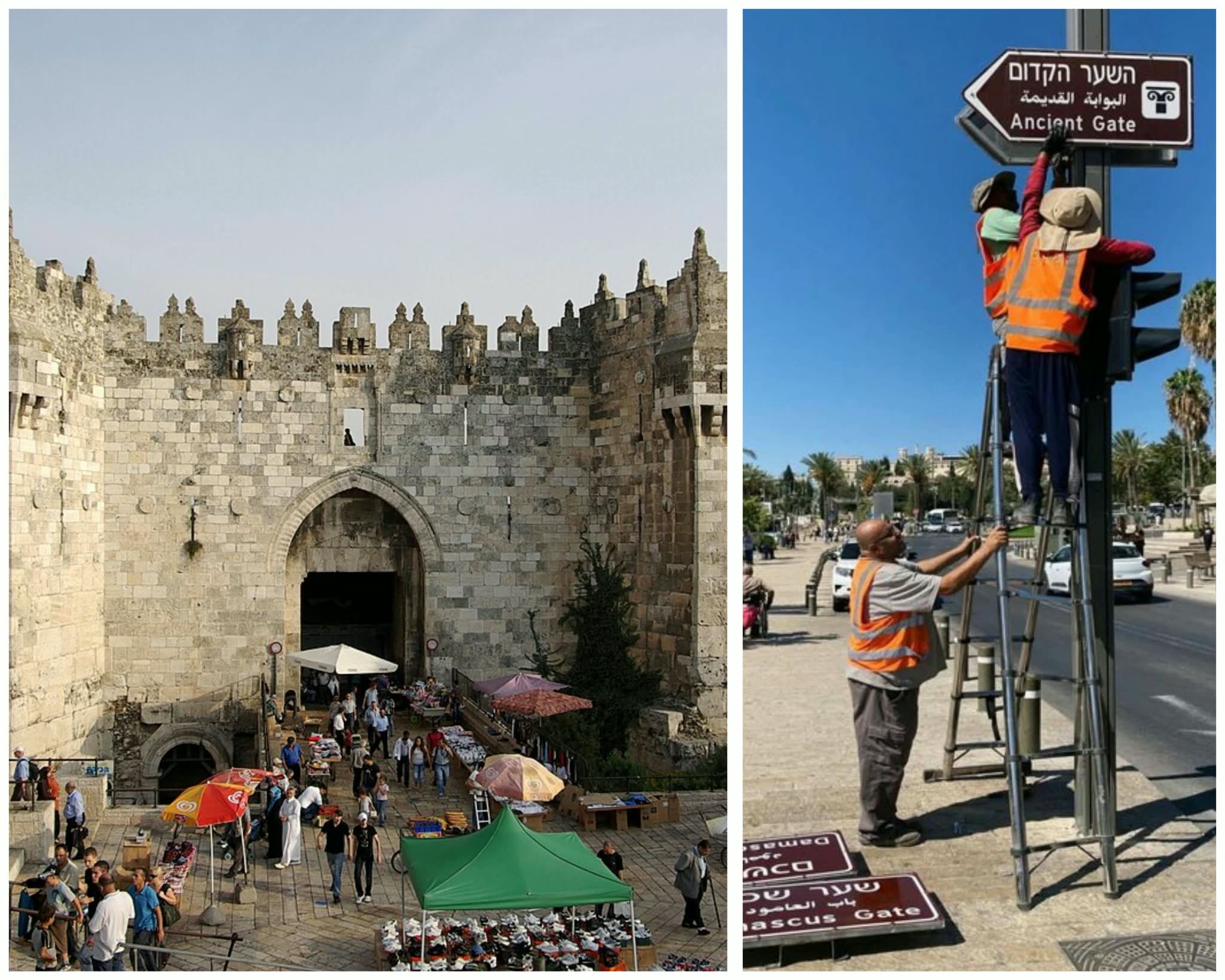
A small sign with enormous significance has now been added to the heart of the struggle over Jerusalem’s sovereignty and identity in the Old City: visitors to the Damascus Gate area are discovering that the underground tourist complex located directly beneath it has been given a new identity. The sign now directs passersby toward the “Ancient Gate,” a move that has reignited the heated debate over control of public space and Jerusalem’s historical narrative.
From the official Israeli perspective, represented by the Jerusalem Municipality, the Ministry of Jerusalem and Jewish Tradition, and the East Jerusalem Development Company, replacing the signage is a necessary professional and tourism-related step. The site, which reopened following extensive conservation work, displays remains uncovered during wide-ranging archaeological excavations at the underground level. Those excavations revealed a monumental Roman triumphal gate with three openings, built in the second century CE on the orders of Emperor Hadrian as part of the Roman city of Aelia Capitolina. Visitors can walk on the original paving stones of the Roman plaza, see an ancient watchtower rising to a height of about 12 meters, and even view remains dating to the Second Temple period.
The authorities emphasize that the name “Ancient Gate” is intended to illustrate the historical depth of these discoveries. The complex also includes an audiovisual presentation depicting the history of Jerusalem’s gates and their importance in Jewish tradition, dating back to biblical times. The stated goal is to connect the public with the story of Jerusalem’s revival as the capital of the Jewish people, precisely at the point where the Roman Empire once attempted to erase that identity entirely.
Why Is the Rebranding Near Damascus Gate in Jerusalem Drawing Palestinian Opposition?
Just a short distance away, however, the Arab public and Palestinian leadership view the name change as a unilateral political step intended to strengthen the Israeli narrative. For Palestinian residents of East Jerusalem, the plaza at “Damascus Gate,” or “Bab al-Amud” in Arabic, is the beating heart of the community and a major center of social, national and cultural activity.
From their perspective, removing traditional names from signs and replacing them with terms that serve the Israeli-Jewish narrative is part of a systematic plan to “Judaize” public space in Jerusalem’s Old City. Palestinian cultural activists warn that the authorities’ focus on the ancient archaeological layers is intended to diminish and erase the significance of the existing Ottoman-era gate above, which is strongly identified with Arab and Muslim history.
Ultimately, the case of the “Ancient Gate” proves once again that in Jerusalem, a seemingly innocent sign is never merely a means of providing directions. It is another front in an ongoing battle over culture and competing narratives, in which every word carved into stone reflects an entire political worldview and actively seeks to shape the face of one of the world’s most complex cities.