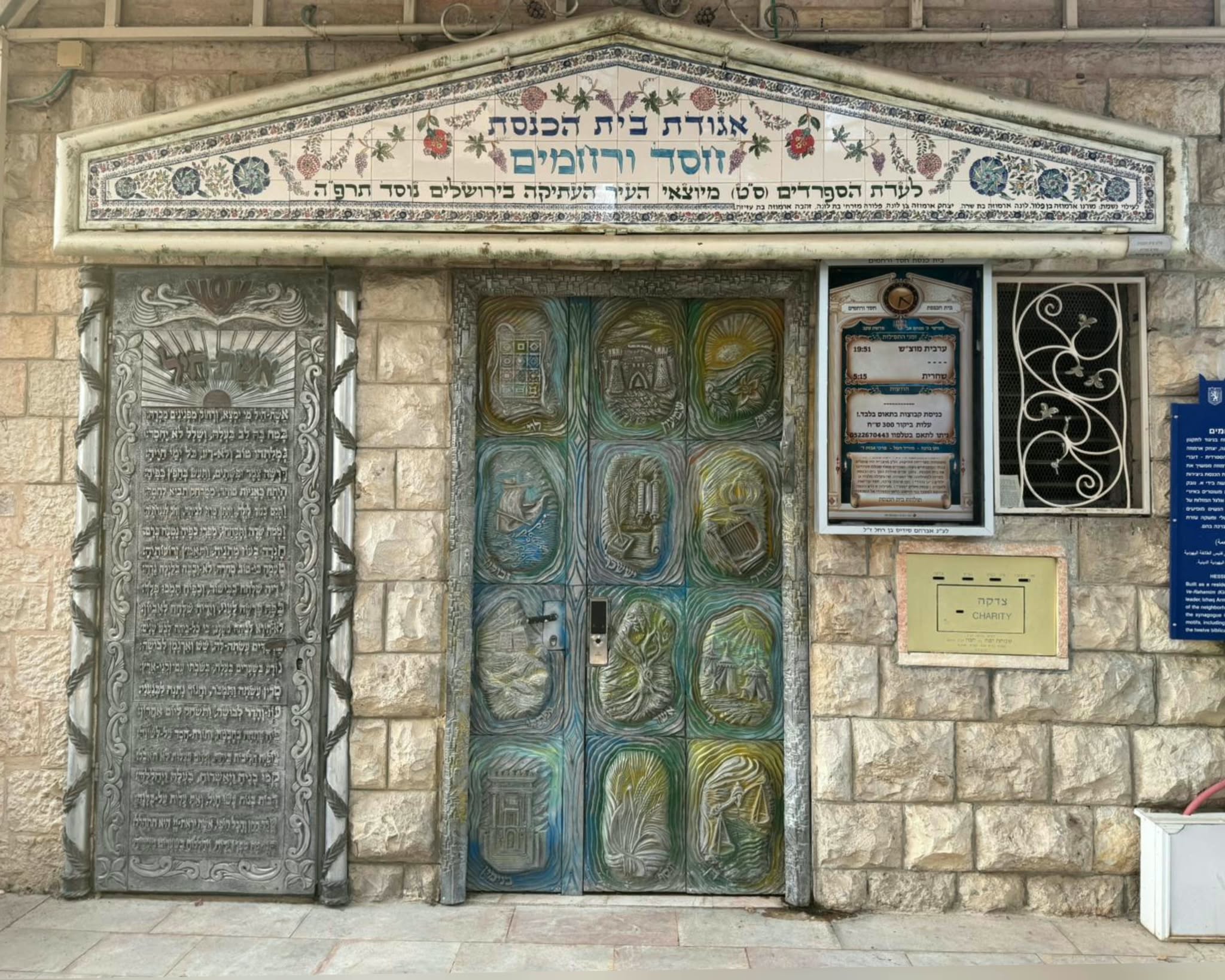
Four in the morning. The Mazkeret Moshe neighborhood is still dark, the shutters are closed, and the streets of Nahlaot have not yet awakened. Jerusalem’s Mahane Yehuda Market, which during the day seems like the beating heart of the city, is still quiet and asleep. But at 18 HaCarmel Street, the lights are already on at the Hesed VeRahamim Synagogue. The open door welcomes those arriving to complete the minyan, and the first whispers gradually give way to the voice of Moni Armoza, the great-grandson of the synagogue’s founder. Another Elul morning begins here, in the same way it began generations ago, by rising in the pre-dawn hours and reciting the prayer: “We have sinned before You, have mercy on us.”
This year, the Hesed VeRahamim Synagogue in Jerusalem marks 101 years since its founding. It was established in 1925 by members of a Sephardic family that had left the Old City. In its early days, the building served as a residence, later becoming a tavern in violation of the neighborhood regulations. Then Isaac Armoza, who was known as the neighborhood mukhtar, worked to establish a synagogue for the local Sephardic community. Today, the Armoza family continues to preserve the family and community connection with determination.
What Are Selichot Prayers Like at the Hesed VeRahamim Synagogue in Jerusalem Before Dawn?
The Selichot prayer is perhaps one of the traditions most closely associated with the High Holy Days. The custom of reciting Selichot in the pre-dawn hours is intended to place a person in a time when the world is quiet, before a new day begins. In the Sephardic tradition, Selichot are recited from the beginning of the month of Elul until Yom Kippur, while in Ashkenazi communities the custom begins on the Saturday night before Rosh Hashanah.
In Jerusalem in 2026, where Selichot have also become a cultural and tourist event, Hesed VeRahamim offers something different: not a performance and not a reconstruction of the past, but a living tradition.
Many synagogues are scattered throughout Nahlaot and around Mahane Yehuda Market, and each has found its own way of dealing with the early hour. Some minyanim have postponed the prayer in order to adapt it to modern life. People who went to sleep late because they were watching series on Netflix will recite Selichot at seven in the morning, but at Hesed VeRahamim they continue to rise while the night is still present.
And perhaps that is the larger story of this place. In a neighborhood that has changed, alongside a market that has become a major leisure destination for young people, families and tourists, the synagogue continues to open its doors to anyone who wishes to enter. Morning prayers are held there every day, festive services take place on Shabbat, and the synagogue accompanies members of the community through family milestones, from being called up to the Torah to blessings for a newborn and groom’s Shabbat celebrations.
It is a synagogue that offers a spiritual experience alongside artistic beauty, accompanied by the sounds of the Sephardic-Jerusalem tradition and an atmosphere that is difficult to recreate anywhere else. A synagogue whose atmosphere is captivating in every sense. One hundred and one years have passed since its doors first opened. Jerusalem has changed beyond recognition, but during the month of Elul, at four in the morning, time stands still at Hesed VeRahamim. Those who arrive at that hour experience the Jerusalem above, ancient and holy.